



#Datasheet
Product and installation data for multi-point rollouts
Power, connectors, optional payment terminal, communications, typical electrical installation and applicable standards. Status: product in development. Availability to be confirmed.
Product in development. Availability to be confirmed.
These data describe the unit and its configuration. Electrical design, civil works, permits and commissioning remain the responsibility of the site owner, the competent authority or the installation company appointed for the project.
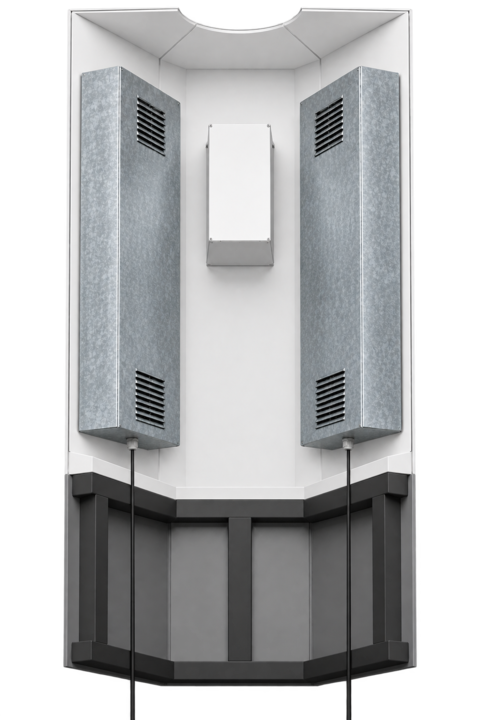
Technical data
| Item | Data | Detail |
|---|---|---|
| Power | Up to 2 × 22 kW | Maximum configured power (44 kW total); available power depends on supply and project. |
| Charging points | 2 × Type 2 | Two vehicles charging simultaneously, subject to available power. |
| Signalling | Perimeter LED | Local status indication for each point. |
| Power sharing | Dynamic balancing | Option subject to metering architecture and configuration. |
| Metering | MID | Available in configurations intended for billing. |
| Remote management | OCPP | Communication with a compatible backend; status in the OCPP status section. |
| Communications | 4G, Wi-Fi and Ethernet | By supplied configuration. |
| Local service | Bluetooth LE | Local setup and service when enabled. |
| Updates | OTA | Dependent on connectivity and platform. |
| Enclosure | Painted galvanised steel | Metal enclosure. |
| Protection | IP54 internal compartments | Declared protection for internal compartments. |
| Maintenance | Removable plinth | Access for maintenance and inspection. |
Typical electrical installation
| Distance to AC switchboard | Cable section | Cable diameter | Power | Conduit diameter |
|---|---|---|---|---|
| 40 m | 5 × 16 mm² | 25 mm | 44 kW | 90 mm |
Reference values for a 44 kW configuration. Final sizing belongs to the electrical project.
Optional payment terminal
When the project includes a payment terminal, each unit can charge on its own, without relying on a separate app or RFID card. Provider and scope are defined per project.
| Payment method | Detail |
|---|---|
| Credit and debit | Card stripe and physical card reading. |
| Contactless | Contactless card or mobile. |
Connectors and signalling
Each side includes a MENNEKES Type 2 connector. The perimeter light ring shows the status of the point: available, authorised, charging or faulty.
| Element | Detail |
|---|---|
| Connector | MENNEKES Type 2, one per side. |
| Lid | Closed at rest, open during a session. |
| Perimeter LED | Local status of each point. |
Capabilities by layer
| Layer | What it provides and what it depends on |
|---|---|
| Hardware | Two Type 2 outlets, metering, signalling, connectivity and local control included by configuration. |
| Protocols | OCPP communicates states, commands and sessions to a backend. |
| Platform | AITHANEX or a compatible backend provides users, tariffs, history, alerts and remote operation. |
| Integrations | Payment, charging networks and the operator's management systems depend on third parties, compatibility, contracts and configuration. |
Base technology
Technology based on AITHA Core: electronics, firmware and remote updates from the group’s reusable base. Management can run on AITHANEX or compatible OCPP platforms.
Deployment scenarios
| Scenario | Detail |
|---|---|
| Public streets | Publicly accessible points integrated into street furniture. |
| Car parks and private operators | Pay-and-display car parks, workplaces, retail and business parks with shared bays. |
| Fleets | Depots and logistics centres charging several vehicles on the same infrastructure. |
| Councils and authorities | Intended scenario: charging programmes built on existing street furniture. |
| Installation at scale | Several units across different locations, connected to a single management backend, by project. |
| Urban renewal | Reuse of supports where technical assessment and authorisation allow. |
| Less civil work | VIAL can use existing street lights, poles, inspection chambers and conduits to install the charging point. |
Remote management and OCPP
OCPP (Open Charge Point Protocol) is a standard protocol that defines communication between chargers and management platforms: states, commands and sessions. It allows several points to be supervised from a single platform and eases integration with billing or the operator’s management systems.
| Aspect | Status |
|---|---|
| OCPP integration | OCPP 1.6: implemented and tested on the previous charger generation; the new charger, in development, keeps it. |
| Third-party networks | Interoperability with third-party networks is evaluated per product configuration. |
| Profile and version | Version as per the status given in this datasheet. Specific functions are confirmed by configuration, electronics and firmware. |
| Platform | AITHANEX or a compatible backend provides users, tariffs, history and alerts. |
Design references
| Reference | Scope |
|---|---|
| Directive 2014/35/EU (LVD) | Low voltage. |
| Directive 2011/65/EU (RoHS) | Restriction of hazardous substances. |
| IEC 61851-1:2017 | Electric vehicle conductive charging system. |
| IEC 61851-21-2:2018 | Electromagnetic compatibility of off-board charging systems. |
| IEC 62196-1:2014 | Vehicle socket-outlets, plugs and connectors. |
| IEC 62196-2:2016 | Dimensional interchangeability requirements for Type 2. |
Installation requirements
| Requirement | Responsible |
|---|---|
| The support (street light or pole) must be structurally and electrically validated before ordering. | Site owner, authority or installer |
| Confirmation of voltage, available power and the nearest supply point. | Site owner, authority or installer |
| External protection and the protection rating required by the project and the site. | Electrical project |
| Existing conduits and inspection chambers reduce civil works where the support allows it. | Electrical project |
| Validation of 4G coverage or Ethernet access for remote management and the payment terminal. | Installer |
| Site authorisations: public-way occupancy or the site owner's permission. | Responsible authority or site owner |
| Legalisation and commissioning per applicable regulations. | Installer |
Data to define before ordering
| Item | What must be confirmed |
|---|---|
| Host pole | Existing street light or pole, structurally and electrically validated first. |
| Electrical supply | Voltage, available power and distance to the nearest AC panel. |
| Civil works | Existing ducting and chambers that can be reused, or a new route. |
| Communications | 4G coverage or Ethernet access, required by remote management and the card reader. |
| Payment | Whether the site needs the card reader or identification is enough. |
| Authorisations | Public-road occupancy, administrative permits or the site owner's authorisation. |
Conditions of application
Scope of the protection rating
- IP54 applies to the internal compartments, not to the installed assembly.
- The protection rating required at the site is part of the project.
The support must be validated before ordering
- The street light or pole must be structurally and electrically validated before ordering.
- Without that validation the location cannot be confirmed.
Site authorisations
- Public-way occupancy depends on the responsible authority; on private land, on the site owner.
- OSHTIA does not handle permits or carry out civil works.
Power and options defined per project
- 44 kW is the maximum configured power, not the power guaranteed at every supply.
- Dynamic balancing, MID metering and the payment terminal depend on the contracted configuration.
OCPP status
OCPP integration
- OCPP 1.6: implemented and tested on the previous charger generation; the new charger, in development, keeps it.
- Interoperability with third-party networks is evaluated per product configuration.
Role within the system
OSHTIA VIAL deploys electric vehicle charging points on public streets, with two connectors per unit. Where the deployment enables it, it reports status and sessions to AITHANEX for remote management and supervision.
| Area | Scope |
|---|---|
| Connectors | 2 per unit. Simultaneous charging of two vehicles. |
| Power management | Distribution of the available load across active sessions. |
| Communication | Reporting to AITHANEX depending on available connectivity. |
| Identification | User and session management. |
Technical flow
| Step | Description |
|---|---|
| 1. Validate and install | Structural and electrical validation of the support before ordering. Mounting on an existing street light or pole; civil works are reduced where the infrastructure allows it. |
| 2. Configure | Power, identification and connectivity parameters from the platform. |
| 3. Operate | The user identifies themselves and starts the session. Power management distributes across active connectors. |
| 4. Supervise | AITHANEX shows the status, sessions and alerts of each connector. |
| 5. Update | OTA from the platform when connectivity and configuration allow it. |
Typical applications
| Setting | Examples |
|---|---|
| Public streets | Existing street lights or poles. |
| Regulated parking | Regulated parking zones in municipalities. |
| Industrial estates | Industrial estates with an outdoor fleet. |
Document information
| Field | Detail |
|---|---|
| Type | Datasheet |
| Product | OSHTIA VIAL |
| System | AITHANEX |
| Audience | Engineering, installation, integration and support |
| Document version | 1.0 |
| Revision date | 2026-10-04 |
| Status | Product in development. Availability to be confirmed. |
Validate the support and the supply before ordering
We review the support, available power, connectivity and operating model before proposing a rollout.